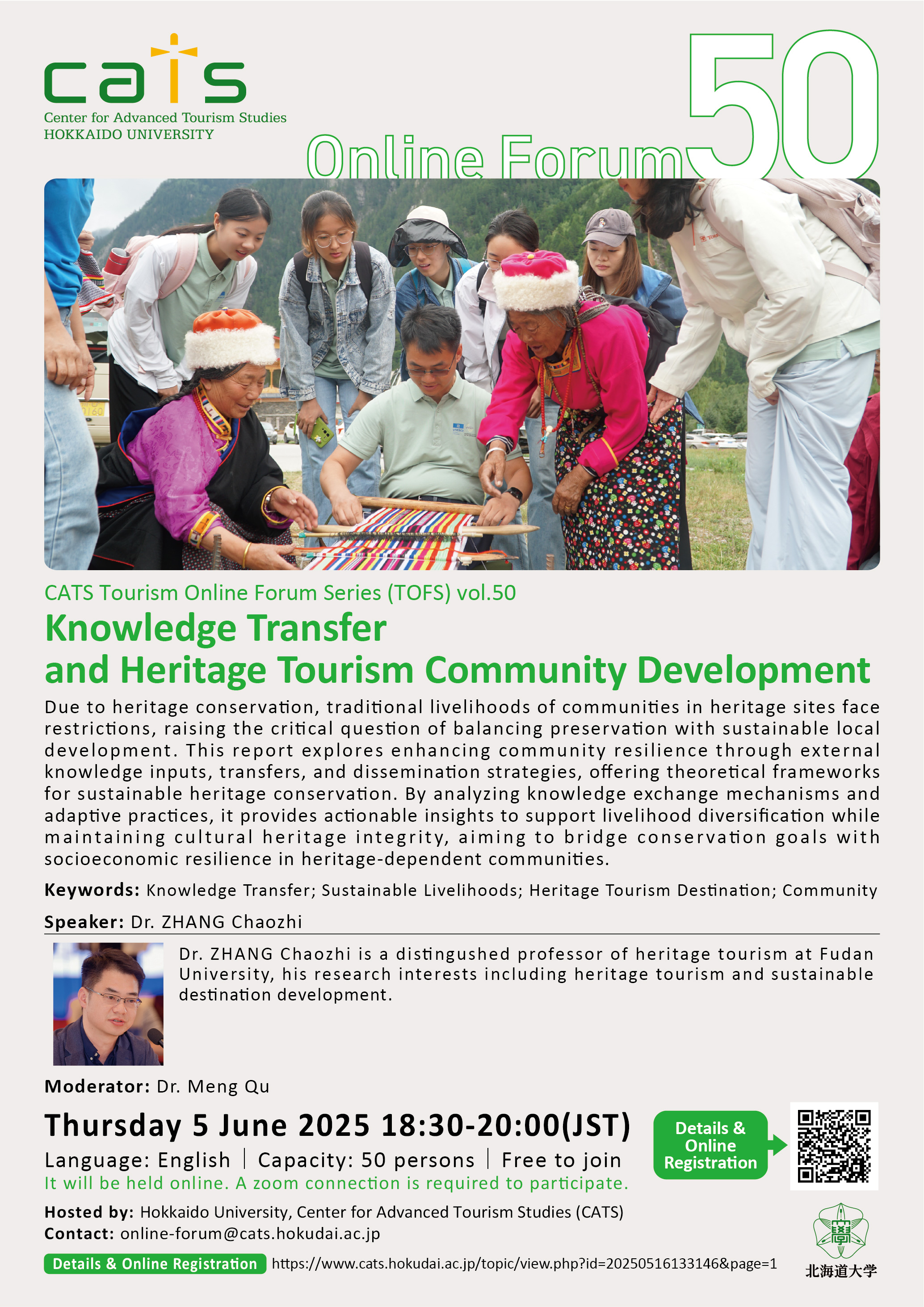
Knowledge Transfer and Heritage Tourism Community Development
Abstract: Due to heritage conservation, traditional livelihoods of communities in heritage sites face restrictions, raising the critical question of balancing preservation with sustainable local development. This report explores enhancing community resilience through external knowledge inputs, transfers, and dissemination strategies, offering theoretical frameworks for sustainable heritage conservation. By analyzing knowledge exchange mechanisms and adaptive practices, it provides actionable insights to support livelihood diversification while maintaining cultural heritage integrity, aiming to bridge conservation goals with socioeconomic resilience in heritage-dependent communities.
Keywords: Knowledge Transfer; Sustainable Livelihoods; Heritage Tourism Destination; Community
Hosted by: Hokkaido University, Center for Advanced Tourism Studies (CATS)
Date/Time: Thursday 5 June 2025 | 18:30-20:00 (JST)
Speaker: Dr. ZHANG Chaozhi Bio: Dr. ZHANG Chaozhi is a distingushed professor of heritage tourism at Fudan University, his research interests including heritage tourism and sustainable destination development.
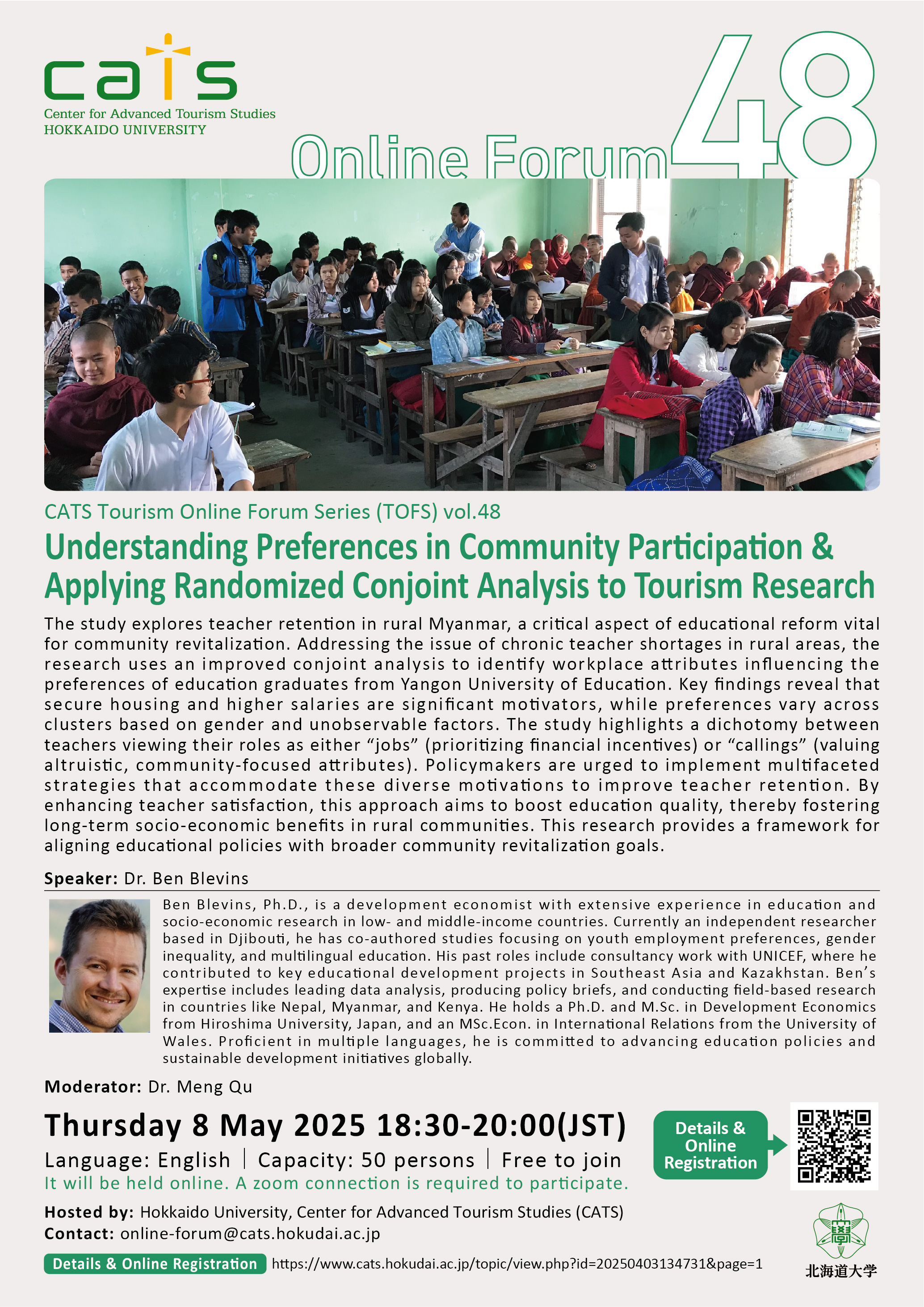
Understanding Preferences in Community Participation & Applying Randomized Conjoint Analysis to Tourism Research
Abstract: The study explores teacher retention in rural Myanmar, a critical aspect of educational reform vital for community revitalization. Addressing the issue of chronic teacher shortages in rural areas, the research uses an improved conjoint analysis to identify workplace attributes influencing the preferences of education graduates from Yangon University of Education. Key findings reveal that secure housing and higher salaries are significant motivators, while preferences vary across clusters based on gender and unobservable factors. The study highlights a dichotomy between teachers viewing their roles as either “jobs” (prioritizing financial incentives) or “callings” (valuing altruistic, community-focused attributes). Policymakers are urged to implement multifaceted strategies that accommodate these diverse motivations to improve teacher retention. By enhancing teacher satisfaction, this approach aims to boost education quality, thereby fostering long-term socio-economic benefits in rural communities. This research provides a framework for aligning educational policies with broader community revitalization goals.
Hosted by: Hokkaido University, Center for Advanced Tourism Studies (CATS)
Date/Time: Thursday 8 May 2025 | 18:30-20:00 (JST)
Speaker: Dr. Ben Blevins Bio: Ben Blevins, Ph.D., is a development economist with extensive experience in education and socio-economic research in low- and middle-income countries. Currently an independent researcher based in Djibouti, he has co-authored studies focusing on youth employment preferences, gender inequality, and multilingual education. His past roles include consultancy work with UNICEF, where he contributed to key educational development projects in Southeast Asia and Kazakhstan. Ben’s expertise includes leading data analysis, producing policy briefs, and conducting field-based research in countries like Nepal, Myanmar, and Kenya. He holds a Ph.D. and M.Sc. in Development Economics from Hiroshima University, Japan, and an MSc.Econ. in International Relations from the University of Wales. Proficient in multiple languages, he is committed to advancing education policies and sustainable development initiatives globally.
CATS will hold the Tourism Online Forum Series (TOFS) vol.47 on Thursday, April 17. Anyone is welcome to attend. We look forward to your participation.
*This forum has been finished. Archived videos are available on CATS official YouTube.
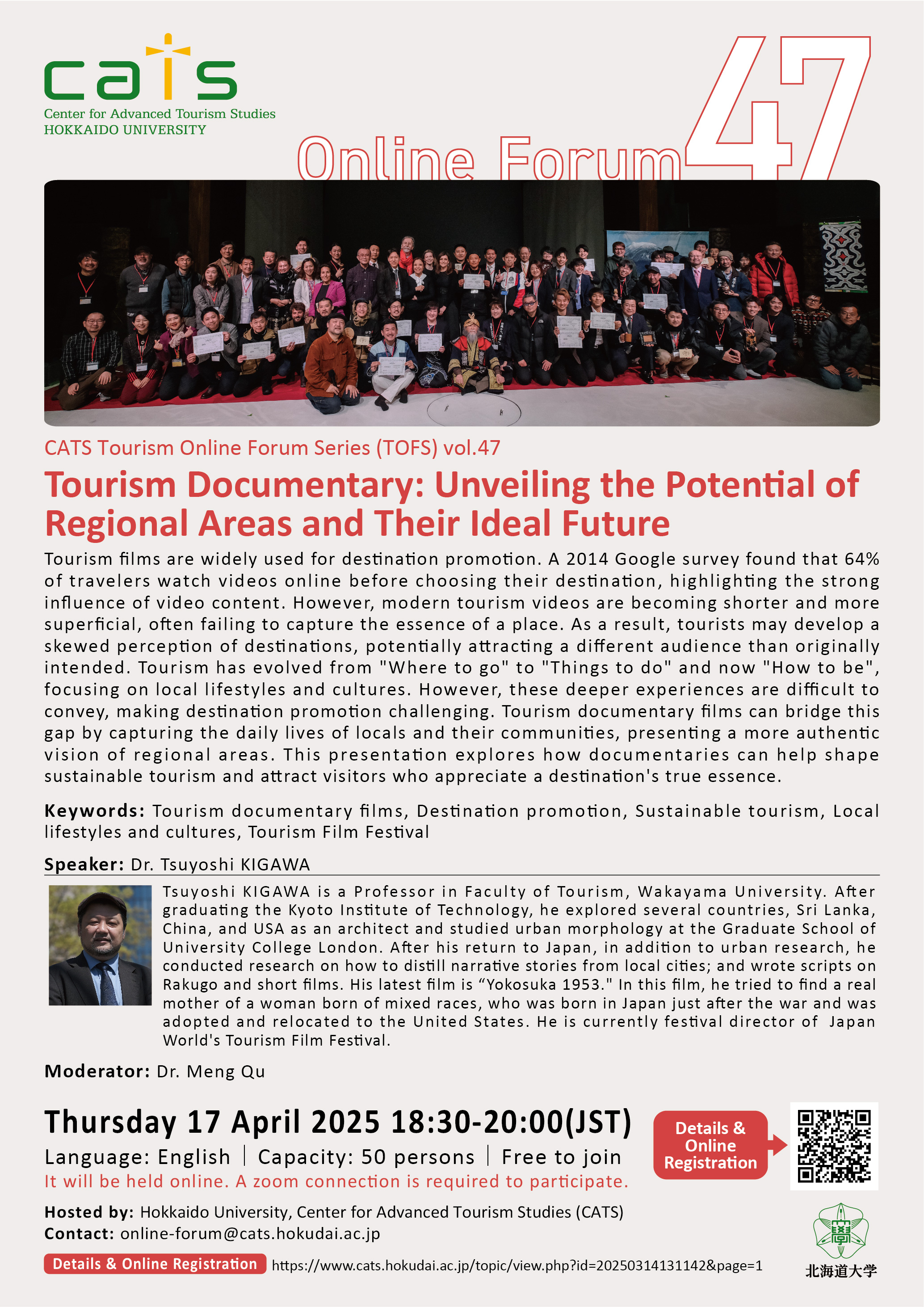
Tourism Documentary: Unveiling the Potential of Regional Areas and Their Ideal Future
Abstract: Tourism films are widely used for destination promotion. A 2014 Google survey found that 64% of travelers watch videos online before choosing their destination, highlighting the strong influence of video content. However, modern tourism videos are becoming shorter and more superficial, often failing to capture the essence of a place. As a result, tourists may develop a skewed perception of destinations, potentially attracting a different audience than originally intended. Tourism has evolved from “Where to go” to “Things to do” and now “How to be”, focusing on local lifestyles and cultures. However, these deeper experiences are difficult to convey, making destination promotion challenging. Tourism documentary films can bridge this gap by capturing the daily lives of locals and their communities, presenting a more authentic vision of regional areas. This presentation explores how documentaries can help shape sustainable tourism and attract visitors who appreciate a destination’s true essence.
Keywords:Tourism documentary films, Destination promotion, Sustainable tourism, Local lifestyles and cultures, Tourism Film Festival
Hosted by: Hokkaido University, Center for Advanced Tourism Studies (CATS)
Date/Time: Thursday 17 April 2025 | 18:30-20:00 (JST)
Speaker: Dr. Tsuyoshi KIGAWA Bio: Tsuyoshi KIGAWA is a Professor in Faculty of Tourism, Wakayama University. After graduating the Kyoto Institute of Technology, he explored several countries, Sri Lanka, China, and USA as an architect and studied urban morphology at the Graduate School of University College London. After his return to Japan, in addition to urban research, he conducted research on how to distill narrative stories from local cities; and wrote scripts on Rakugo and short films. His latest film is “Yokosuka 1953.” In this film, he tried to find a real mother of a woman born of mixed races, who was born in Japan just after the war and was adopted and relocated to the United States. He is currently festival director of Japan World’s Tourism Film Festival.
As part of a project by the Hokkaido University GSI, the documentary UKOAPKAS, directed by Associate Professor Qu Meng from our center, has been released on YouTube.
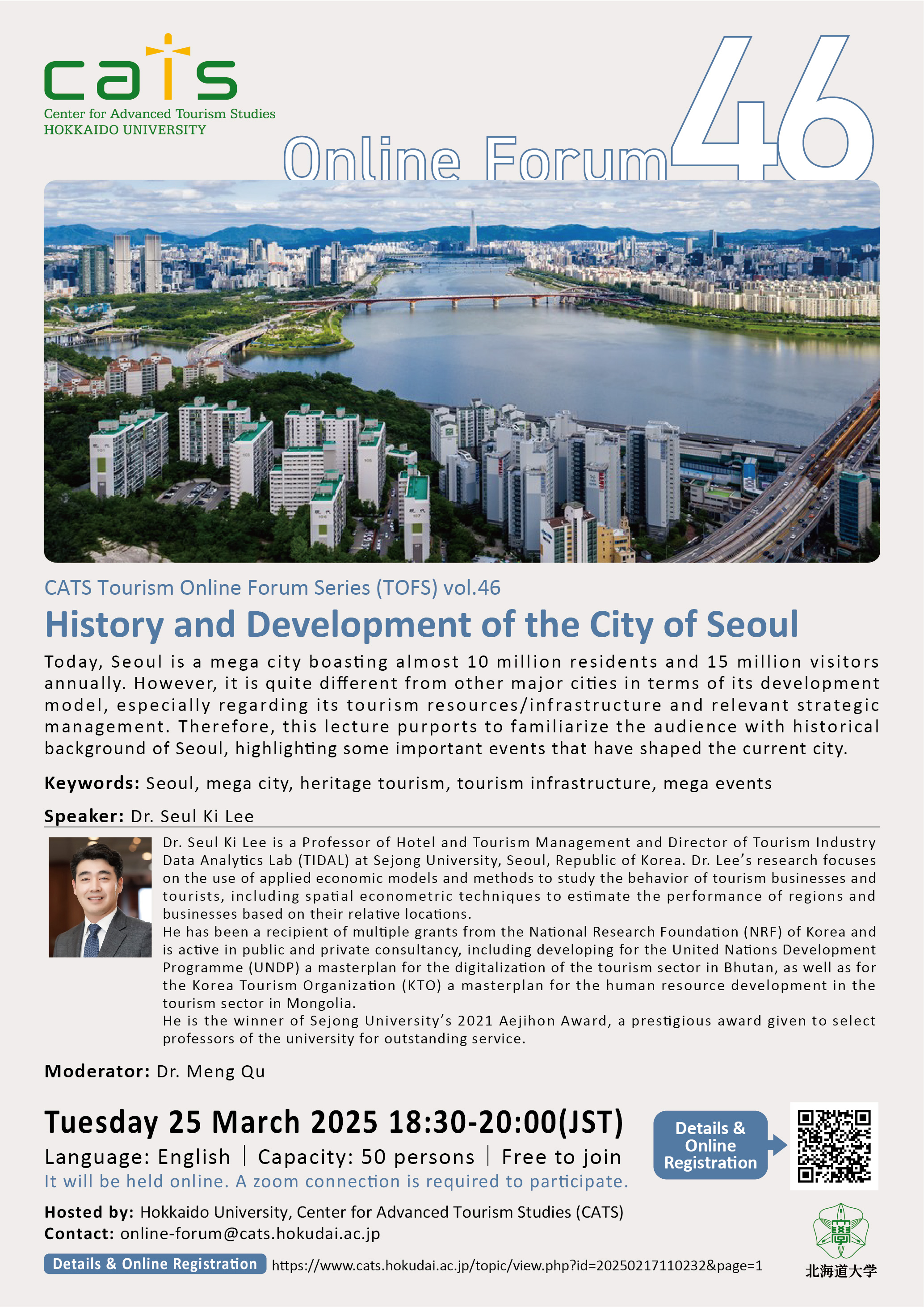
Abstract: Today, Seoul is a mega city boasting almost 10 million residents and 15 million visitors annually. However, it is quite different from other major cities in terms of its development model, especially regarding its tourism resources/infrastructure and relevant strategic management. Therefore, this lecture purports to familiarize the audience with historical background of Seoul, highlighting some important events that have shaped the current city.
Keywords: Seoul, mega city, heritage tourism, tourism infrastructure, mega events
Hosted by: Hokkaido University, Center for Advanced Tourism Studies (CATS)
Date/Time: Tuesday 25 March 2025 | 18:30-20:00 (JST)
Speaker: Dr. Seul Ki Lee Bio: Dr. Seul Ki Lee is a Professor of Hotel and Tourism Management and Director of Tourism Industry Data Analytics Lab (TIDAL) at Sejong University, Seoul, Republic of Korea. Dr. Lee’s research focuses on the use of applied economic models and methods to study the behavior of tourism businesses and tourists, including spatial econometric techniques to estimate the performance of regions and businesses based on their relative locations.
He has been a recipient of multiple grants from the National Research Foundation (NRF) of Korea and is active in public and private consultancy, including developing for the United Nations Development Programme (UNDP) a masterplan for the digitalization of the tourism sector in Bhutan, as well as for the Korea Tourism Organization (KTO) a masterplan for the human resource development in the tourism sector in Mongolia.
He is the winner of Sejong University’s 2021 Aejihon Award, a prestigious award given to select professors of the university for outstanding service.
CATS will hold the Tourism Online Forum Series (TOFS) vol.45 on Thursday, February 13. Anyone is welcome to attend. We look forward to your participation.
*This forum has been finished. Archived videos are available on CATS official YouTube.
Mass and Fiesta Tourism in the Balearic Islands:
Segregation, Elitization, and Green Grabbing
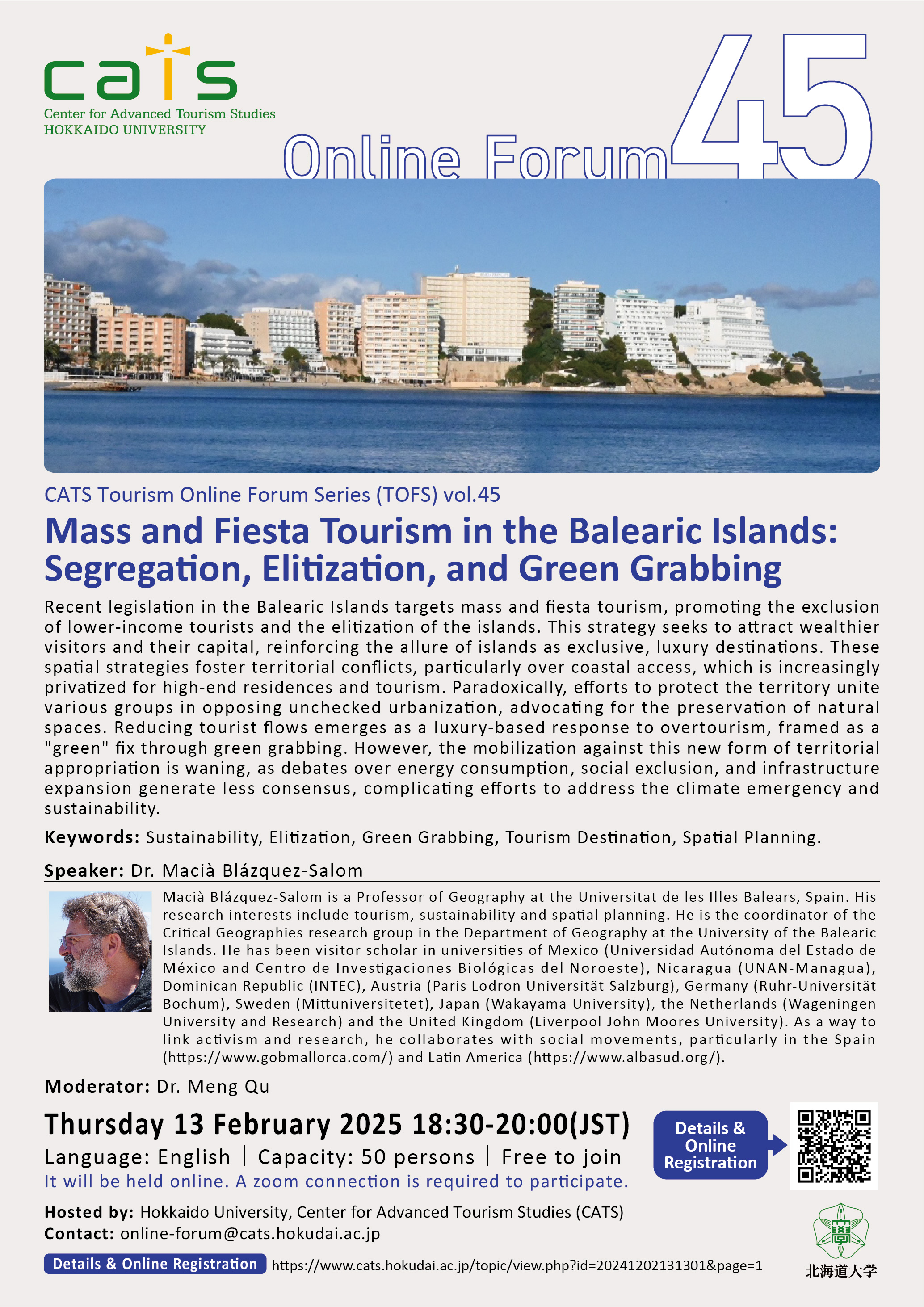
Abstract: Recent legislation in the Balearic Islands targets mass and fiesta tourism, promoting the exclusion of lower-income tourists and the elitization of the islands. This strategy seeks to attract wealthier visitors and their capital, reinforcing the allure of islands as exclusive, luxury destinations. These spatial strategies foster territorial conflicts, particularly over coastal access, which is increasingly privatized for high-end residences and tourism. Paradoxically, efforts to protect the territory unite various groups in opposing unchecked urbanization, advocating for the preservation of natural spaces. Reducing tourist flows emerges as a luxury-based response to overtourism, framed as a “green” fix through green grabbing. However, the mobilization against this new form of territorial appropriation is waning, as debates over energy consumption, social exclusion, and infrastructure expansion generate less consensus, complicating efforts to address the climate emergency and sustainability.
Keywords: Sustainability, Elitization, Green Grabbing, Tourism Destination, Spatial Planning
Hosted by: Hokkaido University, Center for Advanced Tourism Studies (CATS)
Date/Time: Thursday 13 February 2025 | 18:30-20:00 (JST)
Speaker: Dr. Macià Blázquez-Salom Bio: Macià Blázquez-Salom is a Professor of Geography at the Universitat de les Illes Balears, Spain. His research interests include tourism, sustainability and spatial planning. He is the coordinator of the Critical Geographies research group in the Department of Geography at the University of the Balearic Islands. He has been visitor scholar in universities of Mexico (Universidad Autónoma del Estado de México and Centro de Investigaciones Biológicas del Noroeste), Nicaragua (UNAN-Managua), Dominican Republic (INTEC), Austria (Paris Lodron Universität Salzburg), Germany (Ruhr-Universität Bochum), Sweden (Mittuniversitetet), Japan (Wakayama University), the Netherlands (Wageningen University and Research) and the United Kingdom (Liverpool John Moores University). As a way to link activism and research, he collaborates with social movements, particularly in the Spain (https://www.gobmallorca.com/) and Latin America (https://www.albasud.org/).